|
|
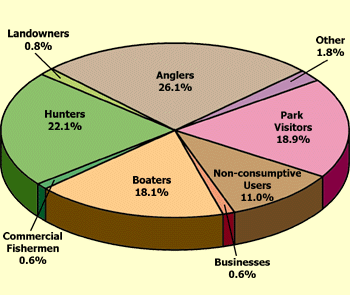
WHO PAYS THE BILLS - ESTIMATED FY 98 REVENUE
|
|
|
|
Texas Parks and Wildlife's appropriations as approved by the 75th Legislature are
$144.3 million for FY98 and $143.9 million for FY99. These amounts do not include a bond appropriation of approximately $60 million or various riders which allow
appropriation of revenues.
All agency revenues, with the exception of the rider appropriation for revenue bonds and debt service, are generated by users of
agency services and products. Over 50% of annual revenues come specifically from hunting and fishing license sales, park entrance and use fees, and boat
registration and titling fees.
|
|
Source: TPW CFO Division.
|
|
According to the Texas Parks and Wildlife Department's Outdoor Recreation Plan, wildlife viewing gained the
largest number of participants in the ten years from 1985 to 1994, increasing from 2.2 million to 4.1 million.*
In a 1993 statewide citizen survey of 2,688 Texans, conducted by Texas A&M, respondents stated that the
most-needed facilities for local communities were bike trails, walking and jogging trails, and nature trails. The need for trails was rated substantially higher than for
other community-based recreational facilities.*
The 2001 comprehensive study and polling conducted for the Texas Tech report on recreation and
conservation issues, showed that "Texans believe that natural resource values are more important than recreational values," and it follows, according to the
polling data, that recreational activities such as bird watching,hiking are more important to Texans than fishing and hunting and boating.*
Many factors influence recreational planning issues: land prices, urbanization, source and availability of
funds, tourism, and population make-up. From 1980 to 1994, Texas's population grew 29 percent. Most of this growth occurred in metropolitan areas. By the year
2030, demographers expect Texas's population will be about 33 million.
This population growth will put more pressure on state and national parks and other natural resources in the state. It
will increase pressure on local governments to provide for recreational open space at a time when land in urban areas will be getting both more expensive and harder to find.
- Texas has an average of 12.2 acres of local parks per 1000 people per 1000 people.
- According to parkland professionals, a goal of 25 acres per 1000 people for local parks is needed. To reach this
goal, an additional 556,722 acres of local parks will be needed by 2030 to reach that goal and to serve the growing demands.*
Approximately 1,387,073 acres of state parkland, historic sites, natural areas and wildlife management areas are
managed by the Texas Parks and Wildlife Deparment, and approximately 35 percent of these lands are leased from the federal government.
- Texas ranks 49th in per capita spending on parkland--sixty-three percent below the national average.
- Texas state government spent $2.71 per person in 1998 and 1999 on parks and recreation, while the average
state spent $14.12.
- According to the Texas Tech study of conservation and recreation needs in Texas, Texas should adopt a goal of
55 acres per 1000 people of state parks. To achieve this goal, the state would need to acquire 1,428,117 acres
of land by 2030 to keep up with the growing population. If wildlife management acreage is included as parkland, the amount of additional parkland needed by 2030 would be 1.2 million acres.
Given the concentration of Texans in metropolitan areas, the Texas Parks and Wildlife Department is planning for the
development of state parks closer to urban centers. The Texas Parks & Wildlife Department's 2002 Conservation Plan
established a goal of establishing 4 to 6 state parks of at least 5,000 acres each near major urban areas over the next ten years.* This acquisition goal, according to critics of the plan, would not meet the goal recommended by the Texas
Parks and Wildlife for the 21st Century study, which argued that there should be 55 acres of state parkland per 1000
people. To keep up with population needs and meet the 55 acres per 1000 goal, parkland advocates contend that the
State should acquire 173,000 acres over the next ten years--near urban centers.
Another demographic change that resource professionals expect to affect the Texas park system is the increase in
African American and Mexican American populations, which are expected to make up half of the state's population by
2030. For the past twenty years, minorities have been less likely than Anglos to participate in Texas Parks and Wildlife
Department programs and to use its services. TPWD surveys show that 83 percent of visitors to state parks were
Anglo, 13 percent were Hispanic, 4 percent were African American, and 7 percent were marked down as other.* If this
trend continues, support for public land acquisition could decline. Former TPWD Director Andrew Samson stated, "Our
minority populations are the key to Texas's future. Without minorities' interest in natural and cultural resources and
involvement in outdoor recreation, it is uncertain what the future will hold for Texas's parks and wildlife."*
|
PUBLIC OPINION POLL ON NATURAL RESOURCES AND OUTDOOR RECREATION IN
TEXAS
|
|
RANK
|
ACTIVITY
|
PERCENT
|
|
1
|
Visit Historic Sites
|
41
|
|
2
|
Fishing
|
38
|
|
3
|
Viewing Wildlife
|
34
|
|
4
|
Visit A State Park
|
33
|
|
5
|
Swimming In Natural Waters
|
30
|
|
5
|
Motorboating
|
30
|
|
7
|
Camping
|
27
|
|
8
|
Hiking
|
19
|
|
9
|
Hunting
|
16
|
|
10
|
Canoeing/Kayaking
|
6
|
|
11
|
Mountain Biking
|
5
|
|
11
|
Rock Climbing
|
5
|
|
Percentages are those surveyed who have participated in various Outdoor Recreation during a 12 month period.
|
|
Source: Texas Tech, Texas Parks and Wildlife for the 21st Century, (Lubbock, 2001), 41
|
|
|

















