|
|
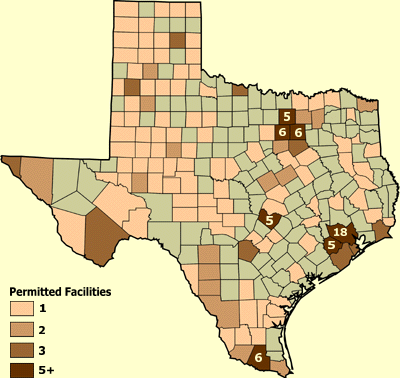
NUMBER OF MUNICIPAL SOLID WASTE LANDFILLS*
IN 1997 BY COUNTY
|
|
|
|
*Permitted facilities officially open at the end of 1997, both active and inactive.
|
|
Source: TNRCC, Annual Reporting Program in Permitted MSW
Facilities: 1997 Data Report (November 30, 2025), Attachment 2.
|
|
In Texas, landfills have been the predominant method of municipal solid waste disposal.
(Nonhazardous industrial waste can be disposed of in some permitted MSW landfills.)
In 2000:
- there were 183 active landfills,
- total landfill disposal for the state in was 28,635,117 tons,
- the per capita landfill disposal rate in was 7.52 pounds per person per day based on a state population of 20,851,820.
In the past ten years, Texans have seen a decline in the number of landfills. In 1986, 250
of Texas's 254 counties had at least one landfill; in 2000, only 139 counties had a landfill. Stricter landfill regulations to protect the environment and human health are forcing
local communities either to ante up with new dollars for redesigning their current landfill or to close it.
Under the amended Subtitle D of the Resource Conservation and Recovery Act of 1976,
stricter pollution controls have been established for landfills. These include restrictions on the locations of landfills and
requirements for landfill liners that capture water that filters through waste, leachate (water that goes through waste)
collection systems, methane gas monitoring, groundwater monitoring, closure, postclosure care, and financial
assurances. Texas has developed new municipal solid waste regulations that reflect these federal requirements.
Though a large number of landfills have been closed, Texas Commission on Environmental Quality (TCEQ) figures
reveal that landfill capacity in the state has not changed much since 1986. Large new landfills are replacing smaller older landfills, and some older facilities have expanded their capacity.
- The average landfill is 172 acres, and is almost 28 feet below the ground and 43 feet aboveground.
- A municipal solid waste landfill can hold approximately 650 pounds of waste per cubic yard of landfill space.
Landfill space is unevenly distributed across the state, however. For some rural residents, transporting waste long
distances to regional landfills has increased disposal costs and has increased the need for transfer stations. Transfer
stations are facilities where various communities bring their waste until it is transported to a permanent site. These
transfer sites can pose the same problems as do landfills: potential groundwater pollution, siting problems, and smell.
In some areas, the loss of a local landfill has increased illegal and potentially harmful dumping.
As more and more municipally owned landfills close, cities and towns are contracting with private companies for waste
disposal. Privatization of waste management has become an issue particularly in smaller communities where one company can exercise a monopoly over this sector of the economy.
- At the end of 2000, 146 (64.3 %)of the state's open municipal solid waste landfills were publicly owned, but they
held 52.2 percent of the available landfill capacity in the state and handled 29 9 percent of the state's total landfill capacity in the state.*
Landfills, both closed and active, can pose potential threats to surface—and groundwater quality and to human health.
Potential groundwater contaminants from municipal waste landfills include, acetone, benzene, tricholoroethylene, lead,
chlorides, and 1,4-dichlorobenzene. In 1993, the Texas Natural Resource Conservation Commission identified at least
24 municipal landfills causing groundwater pollution. Landfills also can be horrible neighbors if odors, debris, rats, and
run off of contaminated water are not controlled. Several neighborhood groups around the state have filed suits against
landfill companies for not meeting up to their operating plans, and preventing these problems.
Landfills can also be a source of energy. Methane gas is one of several gases that are produced when municipal solid
waste decomposes. If uncontrolled, methane gas can explode, but if controlled, it can be a source of energy. Methane
gas is a main ingredient of natural gas. Austin's municipal owned utility has established a methane gas collection
system from a city landfill, and is using the gas in its energy mix to produce electricity.
|
















